Leadership
Managers avoid stepping in early. Feedback arrives late. Expectations don't hold consistently across the team.
First, we map what's getting in the way. Then, we recommend what to do about it.
Most interventions don't stick. The friction that slows teams down usually sits one level deeper: in unclear expectations, avoided conversations, or unnamed assumptions.
We've seen this pattern across hundreds of teams: the presenting problem and the actual problem are often different. A situation analysis tells us where to focus, and gives your managers a shared language for what's been going on — which is the foundation any lasting change is built on.
Managers avoid stepping in early. Feedback arrives late. Expectations don't hold consistently across the team.
Conversations are avoided. Disagreements go unresolved. Misunderstandings accumulate until something bigger forces them out.
People on the same team work from different assumptions about communication, feedback, and how decisions get made.
We use three assessments depending on what's happening in your team. They're not mutually exclusive, the right one depends on what you're trying to understand. We'll help you choose.
For teams where something isn't working, but it's hard to name exactly what.
We map what's actually getting in the way: how people align on priorities and ways of working, how differences in expectations or communication styles are showing up, and where friction is building. Managers bring the situations they're dealing with. We surface where the root cause sits.
What you get: a clear picture of where the issue is, and a recommended next step.
Format: Pre-survey → 1hr call → recommendations
For teams where trust, openness, or collaboration feels fragile.
The Team Scan® measures psychological safety — the degree to which people feel safe to speak up, take risks, and be honest with each other. Based on Amy C. Edmondson's research at Harvard Business School, it looks at four areas:
Attitude to risk and failure: is it safe to try new things, make mistakes, and learn from them?
Open conversation: can people say what needs to be said, even when it's uncomfortable?
Inclusion and diversity: do all team members feel seen and heard, regardless of background?
Willingness to help: do people actively support each other and make it easy to ask for help?
Participants complete a short anonymous survey. You receive an overall Psychological Safety Index (PSI) score and a breakdown by domain — with global benchmarks for context.
Format: Anonymous survey (team) → PSI report with domain breakdown → debrief conversation
For teams working across cultural or linguistic differences.
The Cultural Intelligence® Assessment measures how effectively people work and relate across cultural differences — not just nationality, but differences in communication style, working norms, and how people approach decisions, feedback, and conflict. It covers four areas:
CQ® Drive: motivation and confidence in cross-cultural interactions
CQ® Knowledge: understanding how cultures are similar and different
CQ® Strategy: awareness and planning for multicultural situations
CQ® Action: ability to adapt when working and relating across differences
Participants receive a personal feedback report with scores in each area, compared to worldwide norms, and a personal development plan.
Format: Individual assessment → personal feedback report → debrief

“In each call, their experts demonstrated a genuine interest in understanding our specific needs. And it showed because the final recommendations ended up being unbelievably clear, actionable and feasible for us to execute.”
Korin Cerasuolo
Team Lead, Talent Acquisition, Frontify
“Inklusiiv made it easy to move from understanding and analysing the issues to discussing their recommendations for next steps. They brought in their expertise to every conversation in an insightful and constructive manner.”
Josefina Kotilainen
CEO, Startup Foundation
“From the beginning, it was important for us to get a trusted third party to help us gather and analyse the data — someone who could minimise the impact of our own potential biases. The analysis of the results and actionable recommendations on the next steps have steered us to continue to make a positive impact.”
Noomi Jägerhorn
Director of Sustainability, Posti
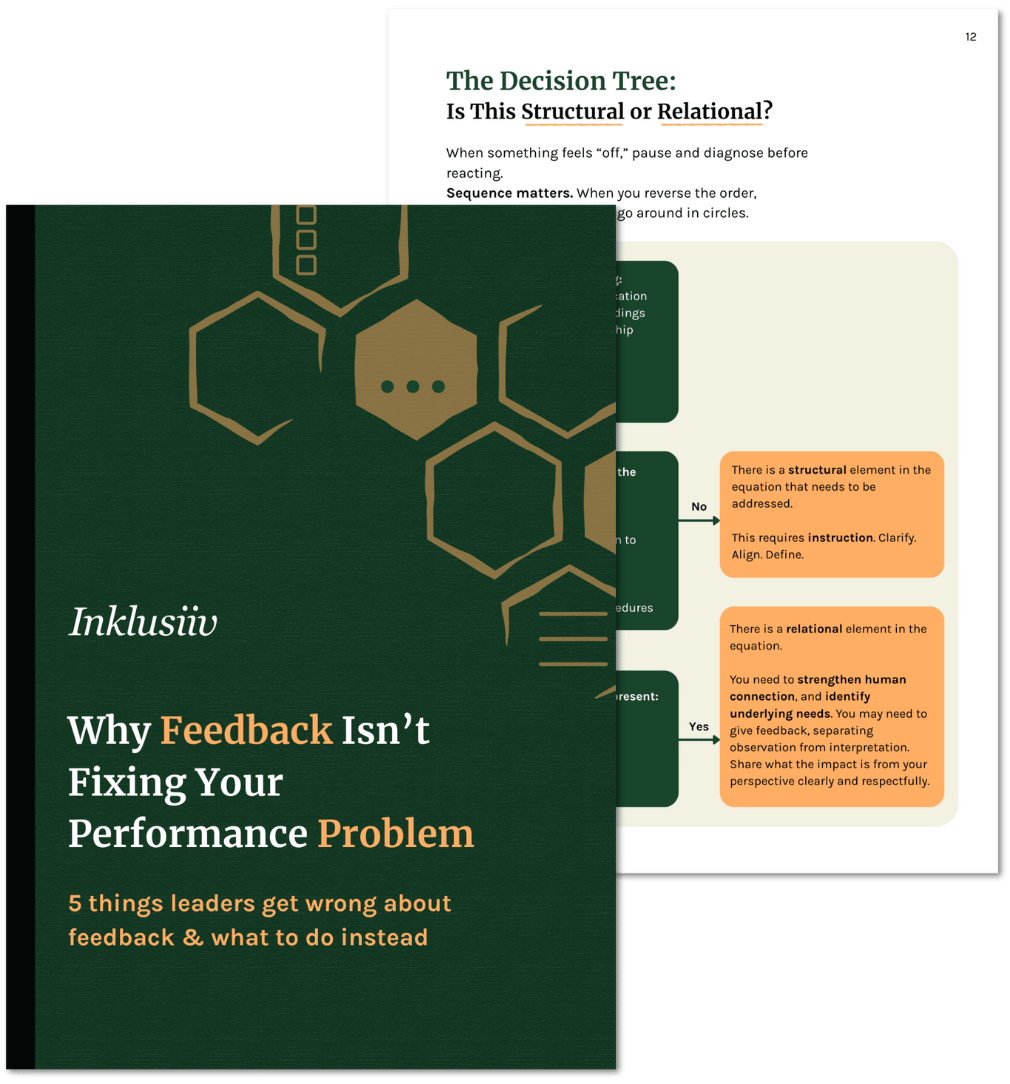
The assessment tells us where to focus. From there, we'll recommend one of two paths.
Targeted skill-building on a specific topic. A single session or short series, designed around what your team needs to work on.
A 6-week Sprint that diagnoses, builds skills, and embeds new practices.
Book a call and we'll figure it out together.

Available in English.

Available in English and Finnish.