Feedback triggers defensiveness
When feedback starts from interpretation instead of observation, the conversation shuts down. People confuse what they interpret with what actually happened.

We work with teams on giving and receiving feedback, handling disagreement, and building shared norms for how people work together.
Recognise this in your team?
People on the same team interpret the same situation differently. When those differences don't get named, small misunderstandings accumulate. What could have been resolved early becomes a pattern.
When feedback starts from interpretation instead of observation, the conversation shuts down. People confuse what they interpret with what actually happened.

Difficult topics get avoided entirely. Hidden tension builds beneath the surface and only comes up when something bigger forces it out.
Without shared norms, people default to their own assumptions about directness, speed, and how disagreement should be handled.

Most team interventions address the relational layer: building trust, improving communication, getting people to engage differently. While that work can help, if the underlying structure is unclear, the friction will keep coming back.
Unclear expectations, undefined decision rights, transitions that were never explicitly named. Unaddressed, these issues become personal.
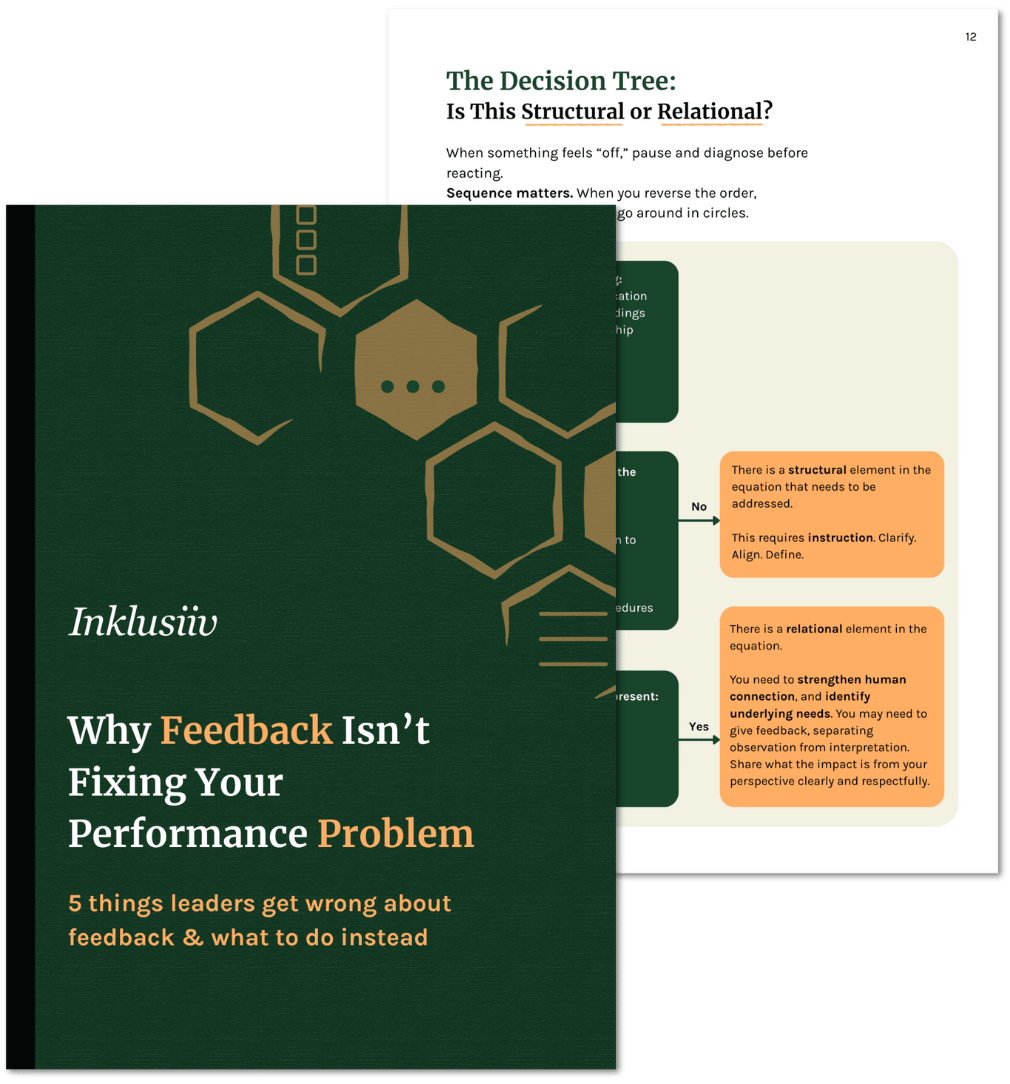
When we come in, we're not looking for who is causing the friction. We're looking for what layer it sits on. There's a distinction that matters more than almost anything else in this work: the difference between a structural problem and a relational one.
Structural problems are clarity gaps — unclear roles, unspoken expectations, transitions that were never named.
Relational problems are about trust and history.
The two often show up together, but usually one is driving the other. Finding which one, and addressing it in the right order, is what changes things.

Consistent across participant feedback on Inklusiiv learning services, 2022–2026.

The City of Helsinki partnered with Inklusiiv to prepare teams and leaders to work effectively with colleagues whose Finnish or Swedish language skills are still developing.
Measures where trust, openness, and willingness to help are strong, and where they're not.
Based on Amy C. Edmondson's research at Harvard Business School.
The assessment tells us where to focus. From there, we'll recommend one of two paths.
Targeted skill-building on a specific topic. A single session or short series, designed around what your team needs to work on.
A 6-week engagement that diagnoses the issue, builds the skills to address it, and embeds new practices. Managers leave with concrete changes in how they lead — measured before and after.
Book a call and we'll figure it out together.

Available in English.

Available in English and Finnish.