
Uncategorized

Leaders often say people are their greatest asset. But how do you attract and nurture talent in a workplace where they are enabled to perform at their best?
That was the question discussed on 15 October 2025, when Inklusiiv, Avant Advisors, and Deloitte Finland — in partnership with AmCham Finland, Boardman, and the Finnish Venture Capital Association — brought together leaders and board members for a conversation on the business imperative of inclusion and how to put it into practice.
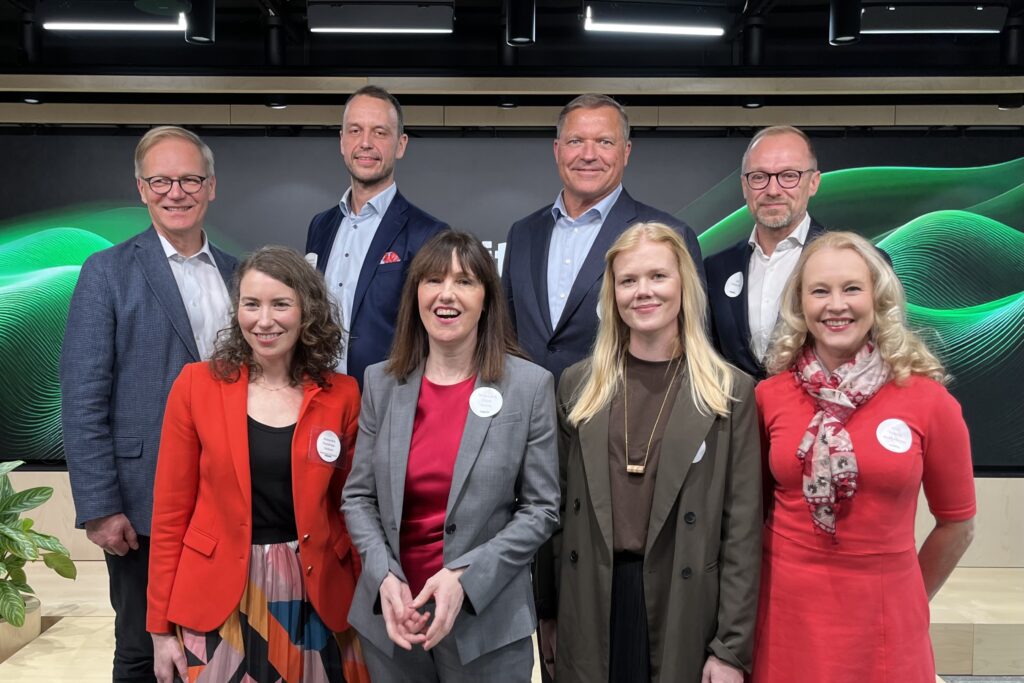 The event featured perspectives from Tuomo Haukkovaara – Partner and Board Member, Boardman, Alexandra Pasternak-Jackson – CEO, AmCham Finland, Samuli Kivilehto – VP, Talent and Development, Metso, Sandra Dillon – VP, Talent & Culture Development, Kemira, Mårten Mickos – CEO in service of startup CEOs, Katja Toropainen – CEO and Founder, Inklusiiv, Lari Hintsanen – CEO, Deloitte Finland, Päivi Paanila – Managing Director, Avant Advisors. (Pictured, from left to right)
Inclusion begins with leadership. “The CEO must believe in it, and the board must hire CEOs who do. Without leadership commitment, inclusion becomes a human resources exercise that creates frustration instead of results.” said Mårten Mickos, CEO in service of startup CEOs.
Lari Hintsanen, Country Managing Partner at Deloitte Finland, linked this directly to the firm’s core promise to clients:
“We won’t succeed in delivering our value proposition to our clients – solving problems that have never been solved before – unless leadership lives by the value of inclusion every day.”
Inclusion demands transparency. Leadership must be willing to change structures and habits that no longer serve their goals: how decisions are made, how people are rewarded, and who is hired. It means bringing in people who think and work differently.
Finnish businesses are struggling to grow because they rely on the same norms, the same people, and the same way of doing things, observed Mickos. We naturally prefer what feels familiar. Leaders need to train themselves, and their organisations, to see the strength in what is different. Inclusion, he argued, is medicine against this stagnation:
“Great people are in the minority, and they are often in minorities. They work harder and perform better. Diverse teams handle difficult times better. When times are good, they innovate faster. They draw from a wider range of perspectives and experiences. Businesses with diverse teams also attract better talent. Great people can choose where to work, and they want to join teams where difference is valued and work feels meaningful.”
Among AmCham’s 200 member companies, the most successful ones make inclusion part of their core leadership competencies, noted Alexandra Pasternak-Jackson, CEO of AmCham Finland.
The panel focused on why inclusion can be challenging and what leaders can do about it in practice.
One key takeaway is that for inclusion to matter, it must be measurable.
“Inclusion can be tracked through authenticity, belonging, equality, access to opportunities, and psychological safety.” – Sandra Dillon, VP, Talent & Culture Development, Kemira.
At Metso, quarterly data show that employee engagement correlates with profitability. “Employee engagement has increased by 36% in the last five years. Customer satisfaction and profits have risen alongside it,” noted Samuli Kivilehto, VP, Talent and Development at Metso. The company found that leadership and inclusion, particularly autonomy and empowerment, are the strongest predictors of success.
Every business decision needs to have a business reason. Investing in inclusion is no exception.
The business case for inclusion can not just be purely symbolic, it should be sound and clear: inclusion helps business grow stronger. As Tuomo Haukkovaara, Partner at Boardman, put it, leaders need to be able to answer a simple question: “What’s the benefit and what’s the cost?”
“Empathy and storytelling matter,” added Pasternak-Jackson. Inclusion is easier to act on when people understand its importance – both to individuals and businesses.
The wider context for the event was the imperative for Finnish businesses to innovate and grow, against a backdrop of Finland’s limited talent pool.“If companies continue with the old ways of thinking and doing things, they risk further narrowing this pool and slowing their growth,” said Haukkovaara.
Inclusion is a leadership choice. It takes intention, humility, and courage.
“Culture will evolve either way, so guide it towards something that helps both people and business thrive,” concluded Mickos.